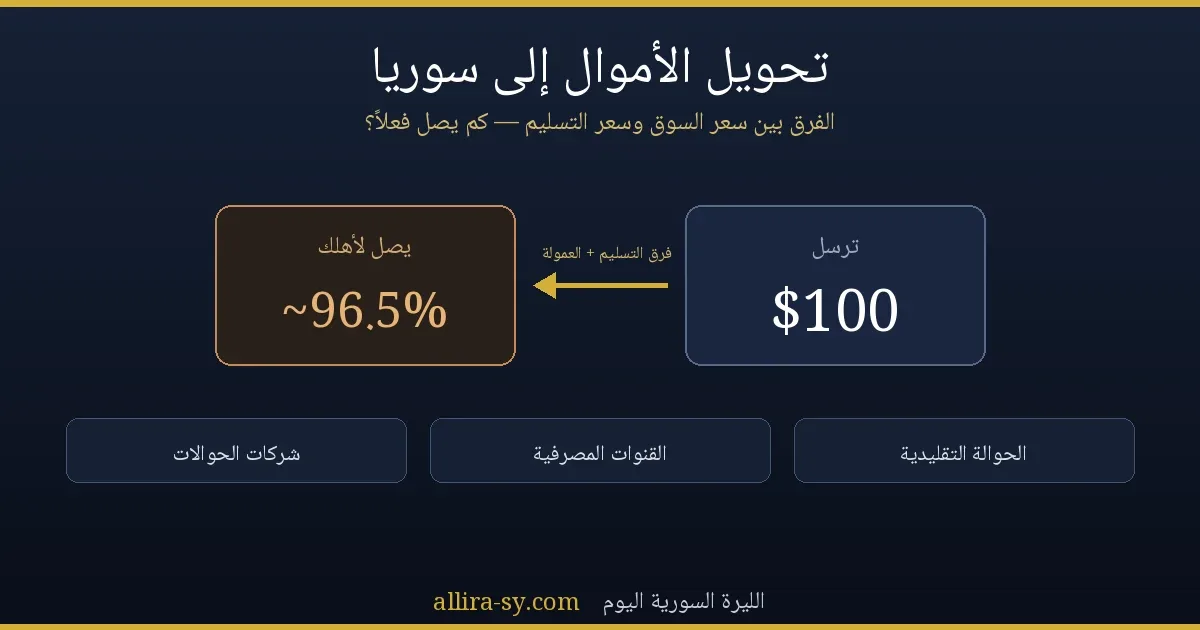
Millions of Syrians in Turkey, Europe and the Gulf send billions of dollars home every year — one of the country's main sources of foreign currency. The question every expat asks: how much of my 100 dollars actually arrives? This guide explains the mechanics clearly.
Available methods
1. Local remittance companies and licensed offices: the widest network inside Syria, receiving transfers from most diaspora countries via agents, usually delivering within hours.
2. Banking and international channels: following the 2025 sanctions-relief path, some official and international channels began a gradual return, though coverage remains limited compared to traditional networks.
3. Informal hawala networks: the oldest and broadest — fast, but with no legal guarantees.
The key point: delivery rate is not the market rate
When you send 100 dollars, your family rarely receives the full parallel-market equivalent. Companies deliver at their own delivery rate, typically below the market rate by a margin that varies by provider, city and conditions — that margin is their real profit on top of the stated fee.
Example: if the market dollar is 14,500 old pounds (145 new) and the delivery rate is 14,000, you lose 500 pounds per dollar — an extra 3.4% on top of the fee. On a 500-dollar transfer, that is significant.
Practical tips before sending
- Ask for the delivery rate first and compare it with the live market rate on our site.
- Compare total cost: a low advertised fee with a poor delivery rate can cost more than a higher fee at a fair rate.
- Record the transfer number and the recipient's name exactly as in their ID.
- Split large amounts across transfers or channels to reduce risk.
- Agree on the currency: cash dollars where available preserve value best.
Watch the rate before you send
Timing matters — the rate moves daily and sometimes intraday. Check the live USD, EUR and TRY rates in old and new pounds before every transfer.
Disclaimer: educational content, not an endorsement of any provider. Verify the license of any company you use.