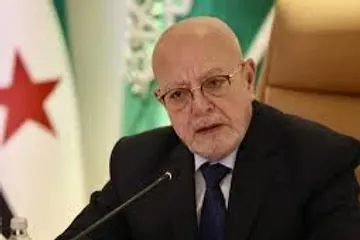
Central Bank of Syria Governor Safwat Raslan confirmed that the bank is implementing a new monetary policy to stabilize the exchange rate in coordination with the Ministry of Finance, noting that monetary policy performance should not be judged solely on the exchange rate, which represents only one of its outcomes. The remarks came during the Syrian-American Business Forum held at the Damarose Hotel in Damascus, as reported by the official SANA news agency.
The Banking Reforms Outlined by the Governor
Raslan explained that the Central Bank of Syria is currently working to update the laws and regulations governing the banking sector, in line with the requirements of reconstruction and future economic development. He noted that Syria's banking sector maintains a solid foundation of compliance with international standards, though it still needs updated legislation and regulatory frameworks suited to the demands of the coming phase. In this context, he revealed short-, medium-, and long-term plans the bank is pursuing to develop the banking sector and build a sustainable banking and economic vision, alongside deeper cooperation with local and international financial institutions. On currency replacement, Raslan pointed to notable progress, with roughly 80% of the money supply replaced so far despite the significant challenges posed by years of war.
A Business Forum Reflecting Syria's Shifting Economic Priorities
The forum takes place amid an accelerating pace of economic and diplomatic activity in Syria since the fall of the former Assad government in December 2024, as international attention gradually shifts from political and security concerns toward genuine investment opportunities in the Syrian market. Exchange rate stability carries particular weight in this context, as it remains one of the primary indicators investors monitor before committing capital, reflecting a central bank's capacity to contain inflation and preserve the purchasing power of the local currency. Modernizing the banking sector's legislative framework is likewise essential to attracting international financial institutions and facilitating transfers and investment flows, especially as government engagement with global financial institutions and chambers of commerce has intensified in recent months.
Available information indicates that the Syrian government, under President Ahmad al-Sharaa, is counting on these economic engagements to draw Arab and foreign capital into the energy, industrial, infrastructure, and services sectors, viewed as core pillars of the country's upcoming economic recovery phase.