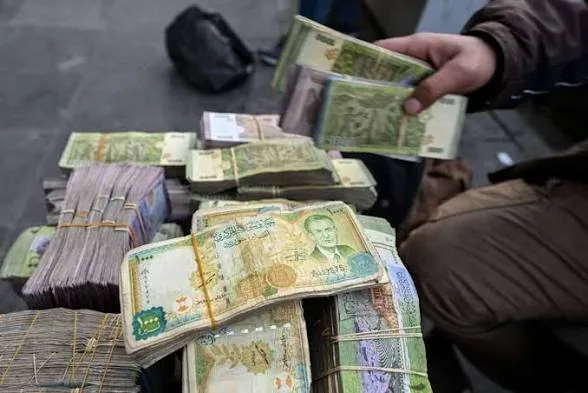
For the third consecutive time, the Central Bank of Syria has issued a decision to extend the deadline for replacing the Syrian currency, a step that reflects the magnitude of the challenges it faces in its plan to replace all currency denominations printed during the era of the ousted regime. The new extension raises questions about the new financial system's ability to complete the replacement process within the specified deadlines and its success in enhancing citizens' trust in the Syrian currency, amidst logistical and organizational challenges facing the monetary and financial sector in the country. This report discusses the implications of the repeated extension of the currency replacement deadline, the most prominent obstacles hindering the implementation of the plan, and its potential repercussions on confidence in the banking system and the national currency, according to a report published by "Syria TV".
Stopping the Circulation of Old Currency Denominations
The Governor of the Central Bank of Syria, Safwat Raslan, announced that the process of replacing old currency denominations with new Syrian Pounds has been completed by over 63% across Syria. Raslan clarified, in a post on the "X" platform last Sunday, that this percentage reflects significant progress in implementing the process and an increase in completion rates, noting that the success of the replacement operation was the result of effective cooperation between citizens and financial institutions. Raslan called on all banks, exchange companies, and money transfer agencies to refrain, during the remaining period, from re-circulating any old currency denominations and to commit to exclusively handing over new Syrian Pounds to customers in all withdrawal, exchange, and cash delivery operations. Raslan affirmed the Central Bank of Syria's full commitment to providing the necessary quantities of the new currency and meeting the needs of citizens and the financial sector, ensuring that the new Syrian Pound will be the exclusively circulated currency after the specified deadline expires.
Motives for Repeated Extension
In this context, Dr. Abdul Rahman Mohammed, Professor of Finance and Banking at the Faculty of Economics at Hama University, explained to "Syria TV" that the reasons that prompted the Central Bank of Syria to extend the deadline are limited to four main factors. Firstly, the weak logistical capabilities of the Central Bank's branches and commercial banks. Secondly, the high volume of old currency (printed before 2010) stored by traders and exchange institutions, which began to appear gradually after each extension, indicating the existence of an old monetary mass that was not accurately accounted for. Thirdly, political and social pressures for fear of the government being accused of confiscating the savings of poor citizens who cannot access bank branches, especially in rural and remote areas. Fourthly, the unavailability of sufficient quantities of the monetary alternative (new denominations of the Pound), either due to a lack of printing or distribution difficulties, hence the bank was forced to extend to avoid paralysis of daily transactions.
Criteria for Success and Failure of Withdrawing Old Currency
Furthermore, Mohammed stated that the criteria he uses to evaluate the government's success in withdrawing old currency from the market are as follows: the ratio of old currency withdrawn to the total targeted money supply. If the ratio is less than 80% after three deadlines, the operation is unsuccessful. The criteria also include the speed of circulation of the new currency in the markets and its acceptance by sellers and consumers, and the volume of complaints registered in banks regarding the refusal to replace large quantities or damaged notes. He pointed out a gap between the replacement of small denominations (2000 Syrian Pounds) and large ones, as the extensions indicate a failure to withdraw smaller denominations specifically due to their daily use. Finally, the gradual decrease or disappearance of old currency from circulation is considered a criterion for success, but what we see so far is its widespread circulation, which means "clear failure."
Erosion of Confidence in the Syrian Pound
Regarding the impact of the extension decisions on citizens' confidence in the Syrian currency, Mohammed noted that repeated extensions cause a serious erosion of trust, stemming from several reasons. It reinforces the citizen's conviction that the Central Bank is unable to implement its decisions, which weakens its prestige and increases the tendency to hold foreign currencies (dollar) or real assets (gold, real estate). Each extension is also seen as evidence that the initial decision was hasty or ill-considered, and is therefore interpreted as the government either hiding facts about the volume of printed currency or dealing with the monetary file with political opportunism. This leads to monetary procrastination behavior, meaning that citizens and traders procrastinate in replacing their old currency in anticipation of new extensions, which disrupts the withdrawal mechanism and makes each subsequent deadline less effective than the previous one. At the banking system level, declining confidence reduces bank deposits in Syrian Pounds and pushes towards direct cash transactions, which weakens banks' ability for financial intermediation.
Repercussions of the Extension on the Parallel Market
As for the impacts on the exchange rate of the Pound against foreign currencies, Mohammed explained that the negative effects are clear through accelerated inflation as a result of the extension. The market interprets the Central Bank's inability to fully withdraw old currency as evidence of a larger monetary mass than announced, which raises inflation expectations and leads to price increases. Demand for the dollar as a hedge has also risen, especially after each extension announcement, as the demand for buying foreign currencies in the parallel market increases. In addition, the gap between the official exchange rate (set by the Central Bank) and the parallel market rate widens, ranging between 100-200% during extension periods, which confirms that the market does not trust the Central Bank's ability to control, according to Mohammed. He added that by monitoring price movements, he noticed that the extensions coincided with inflationary waves, and although a large part of this is due to non-monetary structural reasons (such as sanctions and the fuel crisis), the turbulent monetary decisions exacerbated the situation.
Who Benefits from the Extension?
In the context of the impact of the currency withdrawal process with the extension on the parallel market, Mohammed indicated that it had a dual effect. It temporarily reflected positively on unlicensed exchange traders, as they exploited citizens' need to replace large quantities outside the banking system in exchange for high commissions. It also strengthened the role of the black market as a haven for old currency, where some speculators bought old currency at a significant discount from ignorant citizens or those unable to access banks, then collectively replaced it after each extension, making profits. He warned that the increased reliance on bartering in some rural areas, due to the lack of new liquidity and the difficulty of distinguishing between old and new currency, as well as stimulating monetary smuggling, where some parties found that extending the deadline provides an opportunity to smuggle quantities of old currency out of Syria (via Lebanon or Jordan) and re-introduce it in an organized manner for replacement, which is a money laundering operation.
A Flaw Threatening the Daily Economy of Citizens
Mohammed predicted a fourth extension with a probability of (more than 70%), attributing this to the following reasons: the continued gap between regions, meaning a large portion of old currency is still in the northeastern regions. The unavailability of a monetary alternative for the 2000 Syrian Pound denomination, which will push the bank to extend to prevent market paralysis. Precedents have created a firm expectation among citizens that an extension will occur, and this expectation automatically materializes, thus disrupting any attempt to impose a real final deadline. Regarding the absence of an old 2000 Syrian Pound denomination equivalent in the new currency, he explained that this reflects a serious planning gap, because the old 2000 Pound denomination is the most circulated in daily transactions (for buying bread and transportation), and there is no alternative for it in the new currency. The new 2500 Pound denomination is unsuitable because it is of higher value and lacks the same flexibility. He noted that canceling the 2000 Syrian Pound denomination without an alternative will disrupt the daily economy, and this is likely to lead to increased demand for the new 2500 denomination, but it will not be a substitute, and consequently, there will be a shortage of small denominations, suggesting that this will lead to the issuance of another denomination such as (1500 Pounds).
Currency in a New Color
Mohammed concluded his remarks by stating: The management of monetary policy in Syria needs a radical transformation: from a reactive approach to proactive planning, from hiding information to partial transparency based on real data, and from reliance on central decisions to building partnerships with the private banking sector to implement field operations. He added that a fifth extension is possible if the approach does not change, at which point the new currency will gradually transform into merely another color of the same old paper, without citizens experiencing any improvement in its purchasing power or stability of its value.