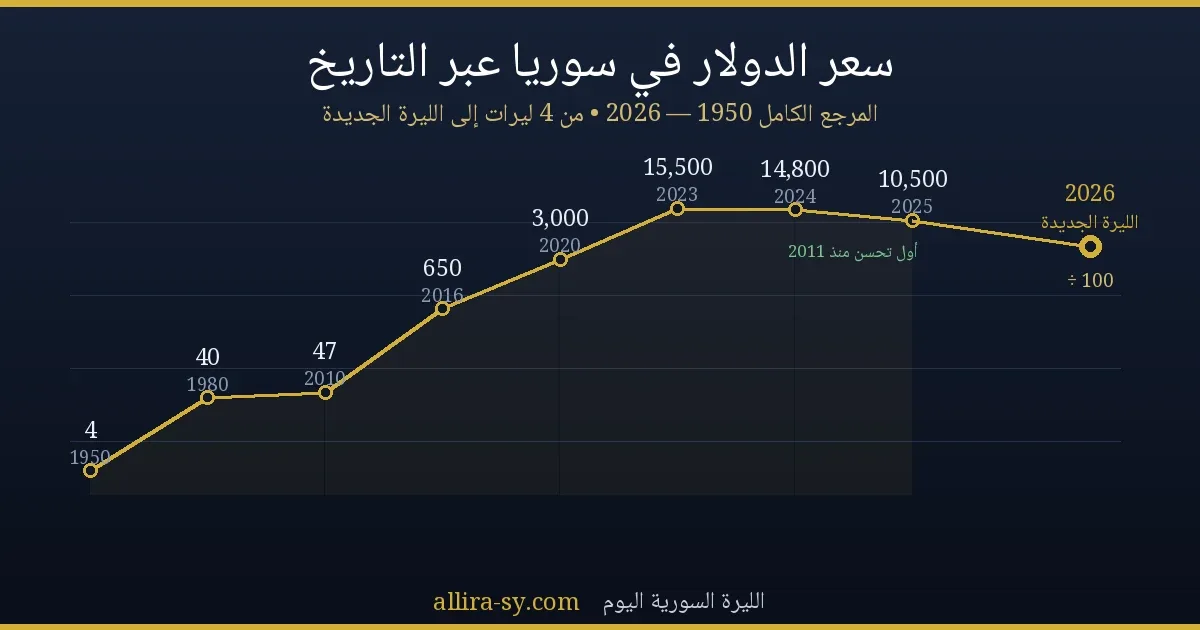
From 3.5 pounds per dollar in 1950, to over 15,000 at the worst moments of 2023, to the complete reset with the new pound in 2026 — Syria's exchange rate story is the story of the country itself. This reference gathers all 76 years in one place. Note: historical figures are approximate and use the parallel-market rate where it diverged from the official one, as it was the people's real reference.
1950s–1960s: the strong pound (3.5 – 4.3)
After independence, the pound was a respected regional currency backed by an active agricultural and trading economy, with the dollar around 3.5–4 pounds. Nationalization in the 1960s added pressure, but the rate held near 4.
1970s: official stability, early parallel market
An official rate near 3.7–4 held throughout the decade, supported by Arab aid and Gulf remittances, while currency restrictions seeded a small parallel market.
1980s: the first great crisis (40+ on the market)
A suffocating economic crisis and sanctions widened the official–market gap dramatically; the parallel dollar passed 40 pounds before a major 1988 official adjustment.
1990s–2000s: two decades of stability (45 – 52)
With Investment Law No. 10 (1991), gradual banking liberalization and private banks entering in 2004, the dollar held a narrow 45–52 range. 2010 — the last calm year — closed near 47.
2011–2020: the war decade (47 to ~2,850)
Ten years in which the dollar multiplied more than fiftyfold: the first shock and sanctions, the 300 peak of 2013, breaking 500 in 2016, then the double blow of Lebanon's banking collapse (2019) and the Caesar Act with the pandemic (2020), pushing past 3,000 for the first time. Full year-by-year detail: the Syrian Pound in the war years.
2021–2023: the most violent collapse (to ~15,000)
A 4,700 peak in early 2021, steady erosion through 2022 (6,000–6,800), then the worst on record: the summer of 2023 broke 10,000 and touched 15,000 before settling at 13,000–14,500.
2024–2025: historic transformation
December 2024 brought the fall of the regime, swinging the pound violently between optimism and anxiety. 2025 delivered the unimaginable: Western sanctions relief, returning official remittance channels, and Decree 293 in September announcing the removal of two zeros. Details: the Syrian Pound 2021–2026.
2026: birth of the new pound
On January 1, 2026 the new Syrian Pound entered circulation at 100 old = 1 new. Track the live USD rate in both currencies on our site.
The complete reference table: 1950–2026
| Period / Year | Approx. USD rate (old SYP) | Key events |
|---|---|---|
| 1950s | 3.5 – 4 | National monetary system founded |
| 1960s | 3.8 – 4.3 | Nationalization wave |
| 1970s | 3.7 – 4 (official) | Arab aid, Gulf remittances |
| 1980s | 4 official → 40+ market | First economic crisis |
| 1990s | 45 – 52 | Investment Law 10 |
| 2000 – 2010 | 46 – 52 | Private banks — the stable decade |
| 2011 | ~70 | Unrest begins, first sanctions |
| 2012 | ~100 | First doubling in decades |
| 2013 | ~140 (peak ~300) | Expanding battlefronts |
| 2014 | ~190 | Central bank interventions |
| 2015 | ~390 | Draining reserves |
| 2016 | ~510 (peak ~650) | Breaking 500 |
| 2017 | ~435 | Frozen frontlines |
| 2018 | ~470 | Relative stability |
| 2019 | ~915 | Lebanon banking collapse |
| 2020 | ~2,850 (peak ~3,100) | Caesar Act, pandemic |
| 2021 | ~3,500 (peak ~4,700) | Partial float |
| 2022 | ~6,500 | Fuel and power crisis |
| 2023 | ~14,000 (peak ~15,500) | The worst collapse — summer 2023 |
| 2024 | 14800 | Fall of the regime — December |
| 2025 | 10500 | Sanctions relief, Decree 293 |
| 2026 | Reset: ÷100 | New pound launch — live rate |
FAQ
When was the dollar at its lowest in Syria? The 1950s–60s at 3.5–4.3 pounds — meaning the dollar multiplied over 4,000 times between 1950 and the 2023 peak.
What was the pound's worst year? In absolute terms 2023 (from ~7,000 to ~15,000 at peak); in percentage terms 2020 (roughly tripling under Caesar, the pandemic and Lebanon's crisis).
Can the pound recover its old strength? A currency mirrors its economy. The 2026 reform is an important organizational step, but real recovery depends on production, investment and stability — a path we document daily in our news section.